
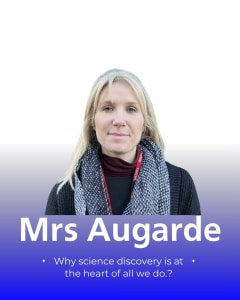
An Interview with Head of Science Mrs Augarde on why science discovery is the heart of all we do.
In an era where space tourism is becoming a reality, AI is reshaping our industries and global challenges require new solutions, Science has never been more vital. It is no longer just a subject on a timetable; it is the very heart of how we understand our past and navigate our future
At The Mead, Science is far more than just a collection of facts and figures; it is a journey of discovery that begins with a single question. We sat down with our Head of Science, Mrs Augarde to talk about science education at The Mead. From her early inspirations in the United States to the hands-on STEM projects taking over our classrooms today, Mrs Augarde shares why she believes every child has the potential to think like a scientist.
How did you get into teaching Science and what do you love most about the subject?
My love of Science began with curiosity and wanting to understand how and why the world works. I have always been drawn to learning through investigation and discovery and teaching Science allows me to share that sense of wonder with children every day. What I love most about the subject is that it encourages questions rather than simply providing answers. It gives children permission to explore ideas, test possibilities and learn from mistakes. Science helps children realise that learning is an active process and that understanding grows through curiosity, perseverance and evidence.
Was there a teacher or moment that inspired you to pursue Science?
Growing up in America, I particularly enjoyed practical, enquiry-based learning, especially science-fair style projects where we researched ideas and presented our own investigations. Those experiences showed me that Science is not just something found in textbooks; it is something you do. That early exposure to hands-on exploration inspired my teaching approach today. I aim to give the children the same opportunity to investigate, create and feel ownership over their learning.
How do you help children engage with trickier scientific concepts?
I believe complex ideas become accessible when children can see, model and experience them. I often use practical investigations, discussion and creative scientific modelling to make abstract concepts tangible. Creativity and collaboration play an important role in my classroom. When children build models, test ideas and explain their thinking to one another, understanding becomes deeper and more lasting. Rather than simply being told information, they actively construct knowledge themselves.
What is special about Science at The Mead?
Science at The Mead is built around enquiry and thinking like a scientist. We have introduced a curriculum that develops key investigative skills such as asking questions, making predictions, planning investigations, analysing data, evaluating results and communicating conclusions. Children gain strong scientific knowledge, often working at greater depth, but they also learn how that knowledge is developed. Each unit culminates in a STEM project where children apply their understanding creatively and practically. Our aim is to nurture curiosity, confidence and independence while developing a genuine love of learning.
How do you balance practical experiments with theory?
Practical work and theory support one another. Experiments provide context and purpose, while scientific knowledge helps pupils interpret what they observe. We often begin with questions or investigations that spark curiosity, then introduce the scientific concepts needed to explain results. This approach helps children see theory as meaningful rather than abstract and encourages deeper understanding rather than simple memorisation.
How do you adapt lessons for children with different learning styles?
Science naturally lends itself to inclusive learning because it combines discussion, observation, hands-on investigation, reading and creative thinking. Lessons include opportunities for collaboration, visual modelling, practical exploration and structured reflection so that every child can access learning in a way that suits them. Differentiation often comes through questioning, challenge tasks and allowing pupils multiple ways to demonstrate understanding.
What steps can children take to explore or learn more about Science outside the classroom?
Curiosity is the best starting point. I encourage pupils to ask questions about everyday experiences -cooking, weather, technology, or nature – and to research answers together with their families. Reading age-appropriate science books, visiting museums, watching documentaries, or simply observing the natural world can all spark further interest. Science is everywhere and noticing it in daily life is often the most powerful learning experience.
Are there any experiments pupils can try at home in the kitchen?
Simple investigations at home can be incredibly valuable. For example, children might explore how temperature affects how quickly sugar dissolves, investigate which materials float or sink, or observe chemical reactions using bicarbonate of soda and vinegar. The key is encouraging children to make predictions, observe carefully, and discuss why results occur – thinking like scientists.
How does Science teaching at The Mead prepare children for senior school and beyond?
Our approach develops both strong subject knowledge and transferable skills. Pupils learn how to question information, analyse evidence and explain their reasoning clearly- skills that are essential for senior school and for lifelong learning. By focusing on enquiry and problem-solving, we aim to build confident learners who are prepared not only for academic success but also for the challenges of an ever-changing world.
What skills do you think Science helps children develop beyond the subject itself?
Science develops resilience, critical thinking, collaboration and independence. Children learn that not every investigation works perfectly the first time and that mistakes are part of progress. They also learn how to support ideas with evidence, listen to alternative viewpoints and refine their thinking – all skills that extend far beyond the science classroom.
What science myth would you love to bust?
One common myth is that Science is only for children who are naturally “good at maths” or who already know lots of scientific facts. In reality, Science is about curiosity, creativity and persistence. Anyone can be a scientist if they are willing to ask questions, explore ideas and learn from evidence – and that is the mindset we aim to foster at The Mead