
What Does It Actually Take to Build a Confident Learner?
At the very heart of an outstanding education lies a simple ambition: to nurture children who approach challenge with composure, curiosity and confidence.
A confident learner is not defined by flawless performance, but by their readiness to engage with the unfamiliar. They are undeterred by complexity, comfortable with uncertainty, and assured in their ability to make sense of the world around them. True confidence in learning is built when children believe: “I may not know this yet – but I know how to approach it.”
This kind of confidence is not accidental. It is carefully cultivated – through a balance of academic rigour, meaningful opportunity, and a culture in which every child feels secure enough to take intellectual risks. When this balance is right, a lifelong love of learning naturally follows.
1. The Value of the Stumble
If children are afraid of getting it wrong, they will only ever aim for what feels safe.
Perfectionism quietly limits progress. To build genuine confidence, we must actively normalise the stumble. When a child begins to see a mistake not as failure, but as useful information, everything changes. They take more risks. They think more deeply. They try again.
In a warm, secure environment – where every child feels known – fear of failure fades. And when that fear disappears, children aim higher.
2. Learning with Purpose
Children engage most deeply when their learning carries meaning beyond the classroom.
Our pupils partnered with interior design experts in Tunbridge Wells to redesign real spaces. Suddenly, learning had weight:
- Maths became practical: calculating scale, proportion and layout.
- Technology became purposeful: using 3D CAD software to bring ideas to life.
- Communication became meaningful: presenting their designs to industry professionals.
Why this matters: When children see their ideas applied beyond the classroom, their confidence grows rapidly. They begin to understand that their thinking has value and that learning has purpose.
3. A Culture of Independence
True independence cannot be taught in a single lesson; it must be lived through a carefully scaffolded journey. We shift the conversation from “Here is exactly how to do this” to “Here is the goal – how do you think we should get there”
Securing the Safety Net (Years 2 & 3): Robust pastoral care ensures our younger pupils feel safe enough to take intellectual risks as they master the fundamentals. A breadth of specialist teaching begins in Performing Arts, Music, Drama, French, Swimming and PE – with Art joining the specialist line-up in Year 3. From Year 3 extended days featuring tea, supervised prep and an array of clubs give them the autonomy to broaden their own interests.
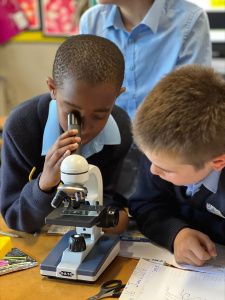
Introducing the Experts (Years 4 & 5): The academic gears shift dynamically. Science is taught by a specialist teacher in Year 4, paving the way for Year 5, where every subject is taught by a dedicated specialist.
The Senior School Blueprint (Year 5 & 6): By Year 5, pupils navigate the school entirely independently – moving between classrooms, locating their own specialist teachers and managing their own equipment.
Why this matters: This is not a sudden transition, but a carefully guided progression – one that ensures independence feels natural, not imposed.
The Outcome
A truly confident learner is one who can step into the unfamiliar and think, with quiet assurance: “I will find a way.”
By combining academic excellence with breadth of opportunity and exceptional pastoral care, we do more than prepare children for the next stage of their education. We equip them with the confidence, judgement and resilience to thrive far beyond it.